
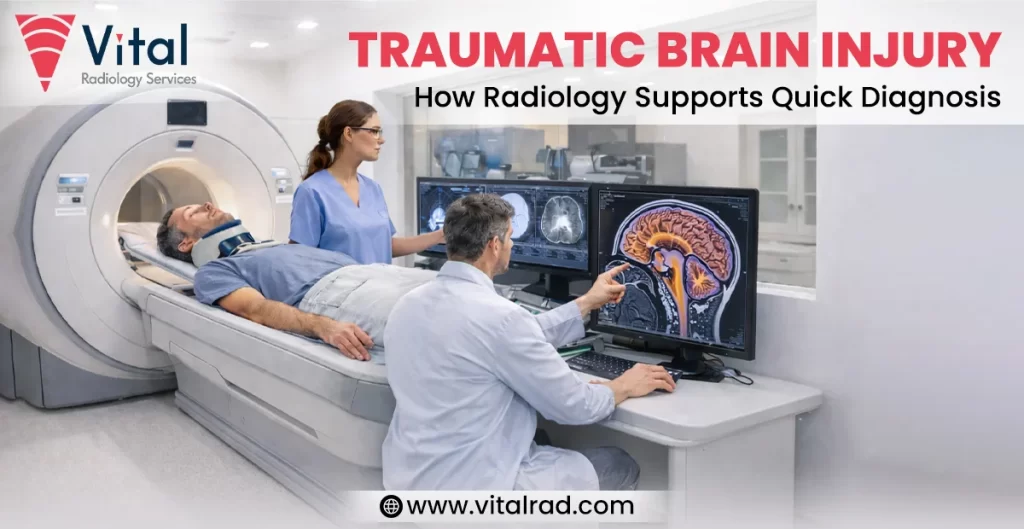

What if a single fall or car crash could silently rewrite your life forever? Traumatic brain injury (TBI) strikes fast; over 2 million cases occur globally each year from bumps, blows, or jolts to the head. These hidden wounds swell the brain, spark bleeding, or snap nerve connections, leaving victims dazed, confused, or trapped in comas. From athletes on the field to kids tumbling off bikes, no one is immune.
Brain injuries demand urgent care because delays let damage spread like wildfire, risking permanent disability or worse. Early diagnosis spots trouble fast, guiding doctors to save lives and limit harm. This article explores how radiology tools speed up TBI detection for better outcomes.
What Are the Causes of TBI?
Traumatic brain injury (TBI) can result from various sudden and forceful events that impact the head or body.
Road Traffic Accidents
- Collisions involving cars, motorcycles, bicycles, or pedestrians are leading causes of TBI.
- Sudden deceleration can cause the brain to strike the inside of the skull.
- High-speed impacts increase the risk of severe bleeding or swelling.
- Lack of seatbelt or helmet use raises injury severity.
Falls and Workplace Injuries
- Slips and falls are common among older adults and construction workers.
- Falls from ladders, stairs, or elevated platforms pose high risk.
- Falling objects at worksites may cause direct head trauma.
- Unsafe conditions and lack of protective gear increase vulnerability.
Sports-Related Trauma
- Contact sports such as football, boxing, and hockey carry concussion risks.
- Repeated head impacts may lead to cumulative brain damage.
- Inadequate protective equipment heightens injury likelihood.
Physical Assault
- Blunt force trauma during violence can cause serious brain injury.
- Shaken or struck individuals face risk of internal bleeding.
Types of Traumatic Brain Injury
Traumatic brain injuries are classified by severity and by whether the skull is penetrated, which helps determine urgency of care and treatment approach.
Mild TBI (Concussion)
- Caused by a brief blow, bump, or jolt to the head.
- May involve short loss of consciousness or none at all.
- Symptoms include headache, dizziness, confusion, blurred vision, and nausea.
- Memory gaps around the event are common.
- Most people recover fully with rest and monitoring.
- Repeated concussions can increase long-term risk.
Moderate TBI
- Loss of consciousness may last several minutes to hours.
- Noticeable problems with speech, coordination, or attention may occur.
- Imaging often shows bruising, bleeding, or swelling in the brain.
- Hospitalization is usually required for observation.
- Rehabilitation may be needed for cognitive and physical recovery.
Severe TBI
- Extended unconsciousness or coma lasting hours to days.
- Significant bleeding, swelling, or tissue damage visible on scans.
- High risk of permanent neurological impairment.
- Requires emergency surgery or intensive care.
- Long-term rehabilitation and support are often necessary.
Open vs. Closed Head Injuries
- Closed injury: Skull remains intact; internal movement causes damage.
- Open injury: Skull fracture or penetration exposes brain tissue.
What are the Common Symptoms of TBI That Require Immediate Imaging?
Spotting these common symptoms after a head injury screams for immediate brain imaging like CT scans to catch hidden damage fast.
- Persistent headache: A throbbing headache that won’t quit, especially if it worsens over hours, signals possible brain swelling or bleeding pressing on tissues; don’t wait, as it can spike pressure inside the skull.
- Vomiting and nausea: Repeated puking without stomach upset points to rising brain pressure from injury, often from bleeding or swelling that irritates the brain’s balance center.
- Loss of consciousness: Even a brief blackout or fainting means the brain took a hard jolt, imaging checks for bruises, fractures, or bleeds that could lead to coma.
- Confusion or memory loss: Acting dazed, forgetting recent events, or struggling to focus shows disrupted brain wiring; urgent scans rule out contusions or swelling affecting cognition.
- Seizures: Sudden convulsions, twitching, or staring spells after trauma stem from irritated or scarred brain tissue, immediate imaging spots blood or injury triggering electrical storms.
Why Quick Diagnosis is Critical in TBI Cases
Rapid diagnosis plays a vital role in managing traumatic brain injury (TBI), as delays can lead to life-threatening complications and long-term impairment.
Risk of Internal Bleeding
Internal bleeding within the skull, known as intracranial hemorrhage, can develop immediately after a head injury or progress over several hours. Blood accumulating inside the skull has limited space and can compress delicate brain tissue. Without timely imaging and intervention, this pressure may disrupt essential brain functions such as breathing, movement, and consciousness.
Early detection through CT scans allows physicians to determine whether surgical drainage or close monitoring is necessary.
Brain Swelling (Edema)
Following trauma, the brain may swell as part of the body’s inflammatory response. However, swelling inside the rigid skull increases pressure on surrounding tissues. Brain edema can reduce blood flow and oxygen delivery, worsening injury. Quick diagnosis helps doctors initiate treatments such as medication or controlled ventilation to reduce swelling and protect brain cells from further harm.
Increased Intracranial Pressure
Rising pressure within the skull is a serious and potentially fatal complication. Increased intracranial pressure can impair circulation and cause additional tissue damage. Immediate identification allows medical teams to act quickly to stabilize the patient.
Preventing Permanent Brain Damage
The primary goal of rapid diagnosis is to prevent irreversible injury. Early imaging guides treatment decisions, improves survival rates, and enhances long-term neurological outcomes.
What is Radiology and Why It Matters in Emergencies?
Radiology is a medical specialty that uses imaging technology to diagnose and monitor diseases and injuries inside the body. It includes tools such as X-rays, computed tomography (CT), magnetic resonance imaging (MRI), and ultrasound. These techniques allow physicians to see bones, organs, blood vessels, and soft tissues without surgery.
Radiologists are trained medical doctors who interpret these images and provide detailed reports to guide treatment decisions.
In emergency medicine, radiology plays a critical role by offering rapid, accurate insight into internal injuries or conditions. Imaging supports quick decision-making during trauma, stroke, or severe pain cases. Because radiologic procedures are non-invasive, they reduce the need for exploratory surgery while still delivering precise diagnostic information. This speed and safety are essential when minutes can determine patient outcomes.
CT Scan: The First Line of Investigation
A CT scan is often the first imaging test performed after a suspected head injury. It is widely available in emergency departments and can produce detailed images within minutes. This speed makes it ideal for critical situations where rapid decisions are necessary. CT scans are highly effective at detecting skull fractures and identifying acute bleeding inside the brain.
In emergency triage, CT imaging helps physicians quickly determine injury severity and prioritize treatment. It can reveal hemorrhage, brain swelling, or pressure changes that require urgent intervention. By providing clear and immediate results, CT scans guide life-saving decisions and improve patient outcomes.
MRI in Traumatic Brain Injury Assessment
Magnetic resonance imaging (MRI) plays an important role in the assessment of traumatic brain injury, especially when detailed soft tissue evaluation is needed. Unlike CT scans, MRI provides clearer images of brain tissue, nerves, and small structural changes. It is particularly useful for detecting subtle injuries such as small contusions, diffuse axonal injury, or microscopic damage that may not appear on initial CT imaging.
MRI is also valuable in follow-up examinations. When symptoms persist despite normal early scans, MRI helps physicians evaluate ongoing brain changes and monitor recovery. This detailed imaging supports accurate diagnosis, treatment planning, and long-term management.
Detecting Different Types of Brain Hemorrhage
Accurate imaging is essential to distinguish between different types of brain hemorrhage, as each requires specific and timely management.
Epidural Hematoma
- Bleeding occurs between the skull and the dura mater (outer brain covering).
- Commonly associated with skull fractures and arterial injury.
- May show a brief recovery period before rapid neurological decline.
- Appears as a lens-shaped collection on CT scan.
- Often requires emergency surgical intervention.
Subdural Hematoma
- Blood collects beneath the dura mater, usually from torn veins.
- Can develop rapidly after severe trauma or slowly over time.
- More common in older adults and individuals on blood thinners.
- CT imaging shows a crescent-shaped blood collection.
- Severity determines the need for surgery or monitoring.
Subarachnoid Hemorrhage
- Bleeding occurs in the space between the brain and surrounding membranes.
- Frequently presents with sudden, severe headaches.
- CT scans confirm presence of blood in cerebrospinal fluid spaces.
- Requires urgent medical evaluation.
Intracerebral Bleeding
- Bleeding occurs directly within brain tissue.
- May cause weakness, speech problems, or seizures.
- Imaging identifies the location and extent of damage.
Role of Radiologists in Rapid Decision-Making
Radiologists play a critical role in rapid decision-making during traumatic brain injury and other medical emergencies. Once imaging is performed, they provide immediate scan interpretation, carefully reviewing CT or MRI images for signs of bleeding, swelling, fractures, or structural damage. Their ability to quickly identify life-threatening abnormalities ensures that no time is lost in initiating urgent treatment. Accurate interpretation within minutes can significantly influence patient survival and recovery outcomes.
Clear communication with emergency teams is equally important. Radiologists promptly relay critical findings to emergency physicians, trauma specialists, and intensive care teams. This direct communication allows clinicians to prioritize care, stabilize the patient, and prepare for potential interventions without delay.
Radiologists also assist in neurosurgical planning by detailing the exact location, size, and severity of brain injuries. Their reports guide surgeons in determining whether immediate surgery is required and helps shape the safest and most effective treatment strategy.
Radiology in Pediatric and Elderly TBI Cases
Radiology plays a vital role in evaluating traumatic brain injury in children, who require special consideration. Pediatric brains are still developing, and symptoms may be subtle or difficult to express. Imaging decisions must balance diagnostic accuracy with safety, especially regarding radiation exposure. Physicians often follow strict clinical guidelines to determine when CT scans are necessary and may prefer observation or MRI when appropriate.
Elderly patients face increased vulnerability due to age-related brain changes and medical conditions. Brain shrinkage can make them more prone to subdural hematomas, even after minor falls. Many older adults also take blood-thinning medications, increasing the risk of internal bleeding. Early imaging is often recommended in this group.
Imaging precautions include minimizing radiation dose, ensuring patient stability, and tailoring scan protocols to age and clinical risk factors.
Monitoring Progress and Treatment Response
Ongoing imaging plays an essential role in monitoring recovery and ensuring effective treatment after a traumatic brain injury.
Follow-up scans
- Conducted to track changes in bleeding, swelling, or healing.
- Help determine whether treatment is working as planned.
- Identify the need for medication adjustments or surgical intervention.
Assessing recovery
- Evaluate improvement in brain structure over time.
- Support correlation between imaging results and clinical symptoms.
- Guide rehabilitation planning and long-term care decisions.
Detecting complications
- Reveal delayed bleeding or increased intracranial pressure.
- Identify infection or fluid buildup.
- Allow early intervention to prevent further neurological damage.
Challenges in Radiological Diagnosis of TBI
Diagnosing traumatic brain injury through imaging presents several clinical and logistical challenges that can affect timely and accurate evaluation. These may include the following:
Mild injuries with subtle findings
- Concussions and mild TBIs often show no visible abnormalities on initial CT scans.
- Microscopic damage, such as diffuse axonal injury, may be difficult to detect.
- Symptoms can persist despite normal imaging results.
- An MRI may be required for a more detailed assessment.
Timing of imaging
- Very early scans may not immediately reveal evolving bleeding or swelling.
- Delayed complications can develop hours after injury.
- Repeat imaging may be necessary when symptoms worsen.
- Clinical judgment is essential in deciding when to rescan.
Access to imaging facilities
- Rural or under-resourced areas may lack advanced imaging equipment.
- Transport delays can affect outcomes.
- Limited availability of specialists may slow interpretation.
Conclusion
Radiology plays a vital role in the evaluation and management of traumatic brain injury. From rapid CT scans in emergency settings to detailed MRI assessments during recovery, imaging provides critical insight into internal damage that cannot be seen externally. Accurate interpretation allows healthcare teams to identify bleeding, swelling, fractures, and subtle tissue injury with precision.
Timely imaging is essential to prevent complications such as increased intracranial pressure and permanent brain damage. Early detection supports faster intervention, appropriate surgical planning, and targeted treatment strategies. By enabling prompt and informed decisions, radiology significantly improves patient outcomes and enhances the overall standard of trauma care.